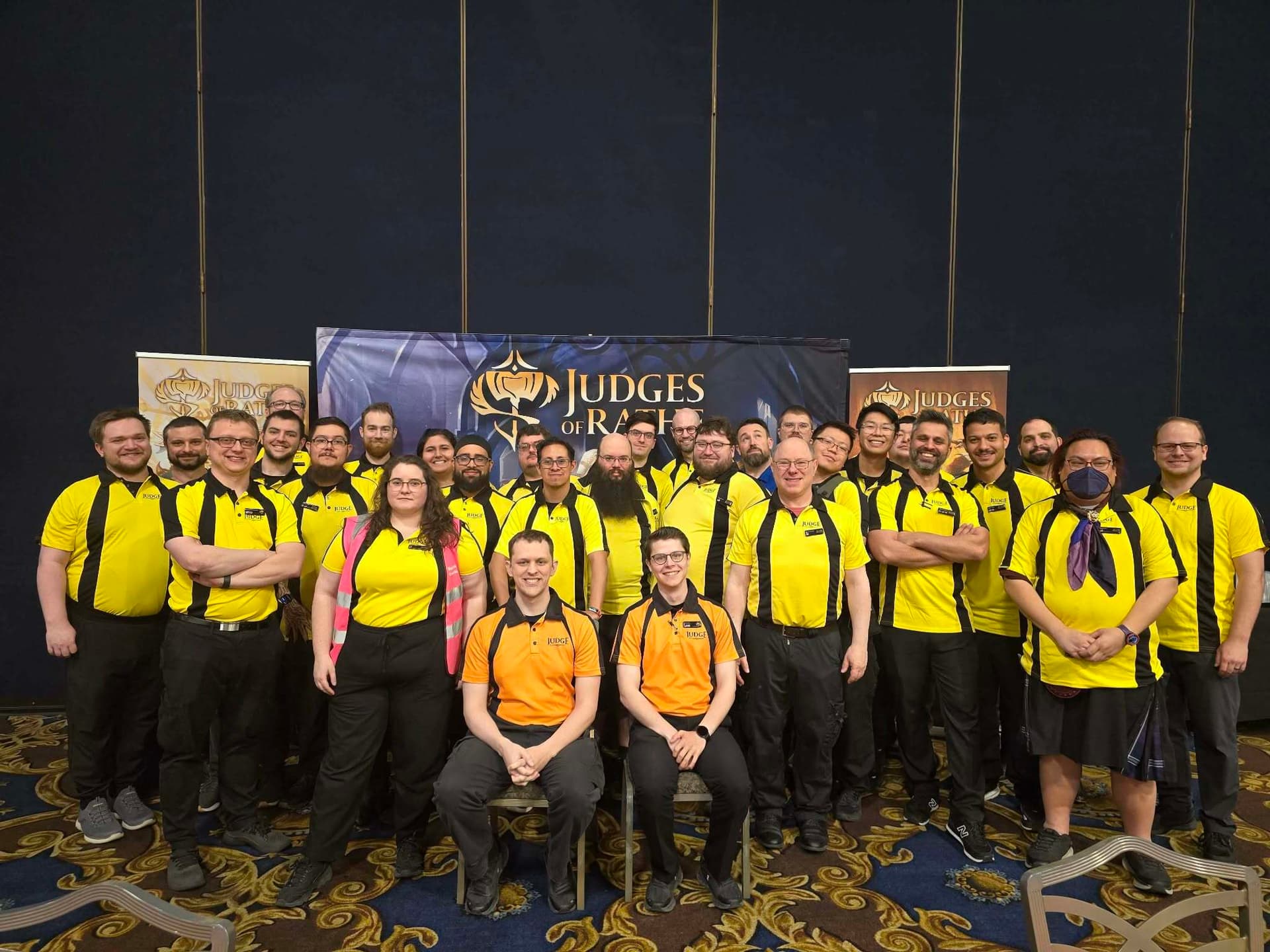
Greetings Judges!
Yes, I understand this report is late, but was finally able to synthesize all that happened and learned to share.
You will be reading it from the context of when I started reflecting after the event, so it might sound like some of it was written just a little after the event, even though it's two months later, cause that is when it was first written. Regardless, hopefully it is insightful and helpful, and I do enjoy any comments and dialogue that comes out of it. Enjoy!
What a whirlwind of a weekend! Just a week after Indianapolis, I found myself back in the judge trenches for US Nationals 2025 in Las Vegas from 6/6–6/8. This event pushed me further outside my comfort zone than any tournament I've worked before, and honestly, I'm still processing everything that happened 🤔
I had the privilege of working under Head Judge Brandon Welch with support judges Ryan Wood & Gerard Trpin for Nationals, and Head Judge John Brian McCarthy with support judges Gerard Trpin and Dan Collins for the Calling. My team leads were Emilien Wild for Features and EoRG, and Joe Kavanagh for Product & Logistics.
This report is going to be different from my previous ones since I didn't take many significant judge calls. Instead, I want to focus on the logistics, team dynamics, and personal growth moments that made this event such a learning experience. If you've never worked multiple teams at a major event or wondered what it's like to feel completely stretched as a judge, hopefully this gives you some insight 🙂
Overview 📝
The weekend was structured as follows:
- Day 1 Nationals: Features team
- Day 1 Calling: End of Round Ghosts (EoRG) team
- Day 2 Calling: Product & Logistics (P/L) team
Working three different teams across two events in three days was ambitious, and I definitely felt it. Between learning new communication tools, adapting to different team dynamics, and navigating the new High Seas meta (yaharrr mateyyy 🏴☠️), I was constantly switching contexts and trying to stay on top of everything.
I'll break this down by each day and team, sharing the logistics I learned, the challenges I faced, and the moments where I felt like I was drowning (and how my mentors helped pull me back up).
Day 1 Nationals — Features Team 🎥
Team Structure and Communication
Working Features under Emilien Wild was both exciting and nerve-wracking. This was my first time on a Features team, and I could feel the scale and pressure at US Nationals. The team consisted of 3 judges and 3 GCAs, and we rotated between overseeing the feature matches and providing floor support.
One thing I learned quickly was how different communication flows work between teams. Features has its own rhythm — quiet observation when matches are running smoothly, quick coordination with GCAs when issues arise, and seamless handoffs when rotating to floor duties. Coming from my experience with End of Round teams where communication and coordination is constant and urgent near the end of round, the Features pace felt almost meditative at times.
The Pressure of High-Stakes Coverage
What struck me most about Features at Nationals was the weight of responsibility. These matches were being watched by hundreds of viewers, featuring some of the best players in the world, and any mistake would be highly visible. Emilien emphasized early on that we exist primarily for the coverage side of the event — we're there to ensure the broadcast runs smoothly and the matches showcase Flesh and Blood at its best.
I found myself second-guessing decisions more than usual. The meta being so fresh (High Seas had only been out for a short time) added another layer of complexity, as I was still getting familiar with new cards and interactions.
Learning to Trust the Process
One moment that stands out was when I hesitated to make a call because I wasn't 100% confident in my ruling on a new High Seas interaction. My instinct was to defer immediately, but Emilien reminded me that taking a moment to think through the problem is exactly what we should be doing. "The worst thing isn't making a mistake," he said, "it's being paralyzed by indecision."
This became a recurring theme throughout the weekend — learning to trust my knowledge while still knowing when to escalate appropriately.
Day 1 Calling — End of Round Ghosts (EoRG) 👻
Switching Gears
Transitioning from Features to EoRG felt like shifting from a waiting game to a very engaged sports match. Where Features required patience, careful observation, and a lot of biding time (since many pros were accustomed to being on features), EoRG demanded constant movement, quick decision-making, and seamless communication with the entire judge staff.
Working under Emilien again but in a completely different context was fascinating. His leadership style adapted perfectly to the team's needs — directive and clear when we needed to move fast, but still supportive when I had questions about procedures.
The Dance of End of Round
EoRG at a Calling is a carefully choreographed dance. We're responsible for sweeping tables, updating statuses in Purplefox, and delegating judges to sit at slow tables, ensuring results get reported efficiently.
I remember feeling overwhelmed during one of the early rounds when we had multiple tables running long, several deck checks in progress, and around the time when many judges were on break, we were so spread thin, judge calls felt nonstop and in queue, and there weren't enough judges to handle the flow of demand. The sheer volume of everything happening while juggling the different tasks and regions I was given was intimidating.
Finding My Rhythm
By the later rounds, I started to find my rhythm. I learned to prioritize information — what needed immediate action, what could be noted for later, and what was just background noise. Emilien was patient with my questions and helped me understand the flow of information from his perspective as team lead.
One thing that helped was setting up systems for myself — taking quick notes on which tables had extensions, which judges were sitting where, and what the general status of the floor looked like. These personal organization methods became crucial for staying on top of everything.
Day 2 Calling — Product & Logistics (P/L) 📦
Another New Team, Another Learning Curve
Day 2 Calling brought yet another team change, this time to Product & Logistics under Joe Kavanagh. If I thought EoRG was fast-paced, P/L was like stepping into a logistics command center. The amount of coordination required for product distribution, deck list collection, and general tournament flow for hundreds of players was staggering.
Joe's approach to leadership was different from both Brandon and Emilien — more focused on delegation and ensuring everyone understood their specific responsibilities. He made sure I knew exactly what my role was and when I needed to execute it, which was helpful given how complex the logistics could get.
The Stress Points
This was the day where I almost broke down a couple of times. The combination of fatigue after two intense days, unfamiliarity with P/L procedures, and the pressure of getting things right for hundreds of players finally caught up with me. I remember one moment where I felt like I had completely messed up the round after taking a stack of papers and trying to slice the seating numbers all at once, but made a miscut, realizing the mistake after a minute of fumbling, and having to reprint the papers to then more slowly, carefully cut the numbers out again, knowing that every judge and player in the room was waiting for me. I was convinced I had ruined the event by adding all those extra minutes.
That's when the mentorship and support from other judges really showed its value.
The "Punting" Conversation
One mentor shared a quote that really stuck with me:
"If you haven't punted a call this weekend, you probably haven't taken enough of them."
When I reflected on it in regards to all the things I was doing, I realized the point wasn't that we get a free mistake when judging. Rather, because I was trying to learn, take on, and balance so many things in a new environment, it was inevitable that a mistake could happen, and I'd stumble somewhere. The goal isn't perfection — it's doing my best, acknowledging failure, then correcting, improving, and learning to move forward. I started viewing those moments as evidence that I was taking on appropriate challenges and pushing myself to grow.
This mindset shift was crucial for getting through the rest of Day 2. Instead of being paralyzed by the fear of making mistakes, I focused on doing my tasks to the best of my ability while being ready to learn from whatever went wrong.
Personal Reflections and Growth 🌱
The Mental Challenge
Working three different teams in three days while learning new meta interactions was the most mentally challenging experience I've had as a judge. Each team had its own communication tools, procedures, priorities, and rhythm. Constantly context-switching between these different environments while maintaining performance standards was exhausting.
I underestimated how much mental energy this would require. By Day 2, I was running on fumes and making mistakes I wouldn't normally make (like doubting simple judge calls or struggling to remember rules clarifications when shadowing other judges). This taught me the importance of self-care and energy management at longer events, especially when working multiple teams.
The Support Network
What struck me most was how supportive the judge community was during my struggles. When I was feeling overwhelmed, multiple judges took time to check in, offer perspective, and remind me that growing pains are normal. The mentorship I received wasn't just about technical judging skills — it was about resilience, self-compassion, and maintaining perspective under pressure.
Brandon, Emilien, Joe, and Gerard all took different approaches to leadership and mentorship, and seeing these different styles helped me understand that there's no single "right" way to guide someone through challenges.
Learning That Perfection Isn't the Goal
One of the biggest lessons was accepting that perfect execution isn't expected, especially when learning new roles. The goal is to do your best, learn from mistakes, and gradually improve. This sounds obvious when written out, but in the moment, under pressure, it was easy to forget.
I realized I was setting unrealistic standards for myself and then getting frustrated when I inevitably fell short. Learning to give myself grace while still maintaining high standards for effort and attitude was a crucial mindset shift.
Technical Learnings 🛠️
Communication Tools and Workflows
Each team used different combinations of communication tools — Discord channels, Purplefox, and even direct communication. Learning to navigate these efficiently while also performing my duties was a challenging but valuable experience at such a high-paced event.
The key insight was that the tools matter less than understanding the information flow. Once I grasped what information each team needed to track and how it moved between different roles, adapting to the tools became much easier.
Team Dynamics and Role Clarity
Working under different team leads highlighted how important clear role definition is. When I knew exactly what was expected of me and when, I performed much better than when I was uncertain about my responsibilities.
This reinforced the importance of asking clarifying questions early rather than hoping to figure things out through context. Each lead had their own style of delegation and communication, and adapting to these differences was part of the learning process.
Meta Adaptation Under Pressure
Navigating High Seas interactions while also learning new team procedures added an extra layer of complexity. I learned the importance of separating these different types of learning — technical game knowledge versus procedural logistics knowledge — and not letting uncertainty in one area undermine confidence in the other.
Food and Logistics Notes 🥪
Despite all the chaos, my pre-event preparation paid off in some ways. I had packed plenty of snacks and stayed hydrated throughout the weekend, which helped maintain energy levels even when everything else felt overwhelming.
However, I underestimated how much additional mental energy the constant team-switching would require. In future events with similar complexity, I'd plan for more substantial meals and potentially more rest breaks to maintain performance.
Final Thoughts 🤔
US Nationals 2025 was simultaneously one of the most challenging and most educational judging experiences I've had. While I didn't take many significant judge calls, the logistics, team management, and personal growth aspects provided more learning than many events focused purely on rulings.
I'm still early in my judging career, and this weekend reminded me how much room I have to grow. But it also showed me that with proper support, mentorship, and the right mindset, I can handle much more complex challenges than I thought possible.
The judge community's willingness to support growth, even when that growth involves visible struggles and mistakes, continues to impress me. The mentorship I received wasn't just about becoming a better judge — it was about developing resilience and perspective that will serve me well beyond judging.
I'm grateful for the opportunity to work with these teams, to push my limits, and to learn from some of the best judges in the program. Each challenge faced this weekend makes me more confident in my ability to handle future complex assignments.
Hopefully you were able to learn something from reading all this! And as always, till next tournament report! 🫡
Special thanks to Brandon Welch, Ryan Wood, Gerard Trpin, John Brian McCarthy, Dan Collins, Emilien Wild, and Joe Kavanagh for their leadership and mentorship throughout the weekend, as well as many who helped read, edit, and give feedback on this TO report in prep for judge consumption. I hope it tastes better than that "sweet sweet" Malört 😉