Greetings Judges!
Thank you everyone for your support and feedback for my first tournament report! 🙇 I was very encouraged as a writer that has always had a small (if non-existent) audience, and honestly did not expect so many people to read it (but I guess when you send an email out to every judge in the program, someone is bound to read it 🤣)
It has inspired and motivated me to try and write a TO report for every judging or larger scale event that I attend, when time permits (as well as when my notes and memory do not fail me 😅)
I apologize that this report is coming out so late, but I still believe it will be of value to others, especially those who have never experienced a larger Calling event, so I hope you enjoy 🙂
Overview
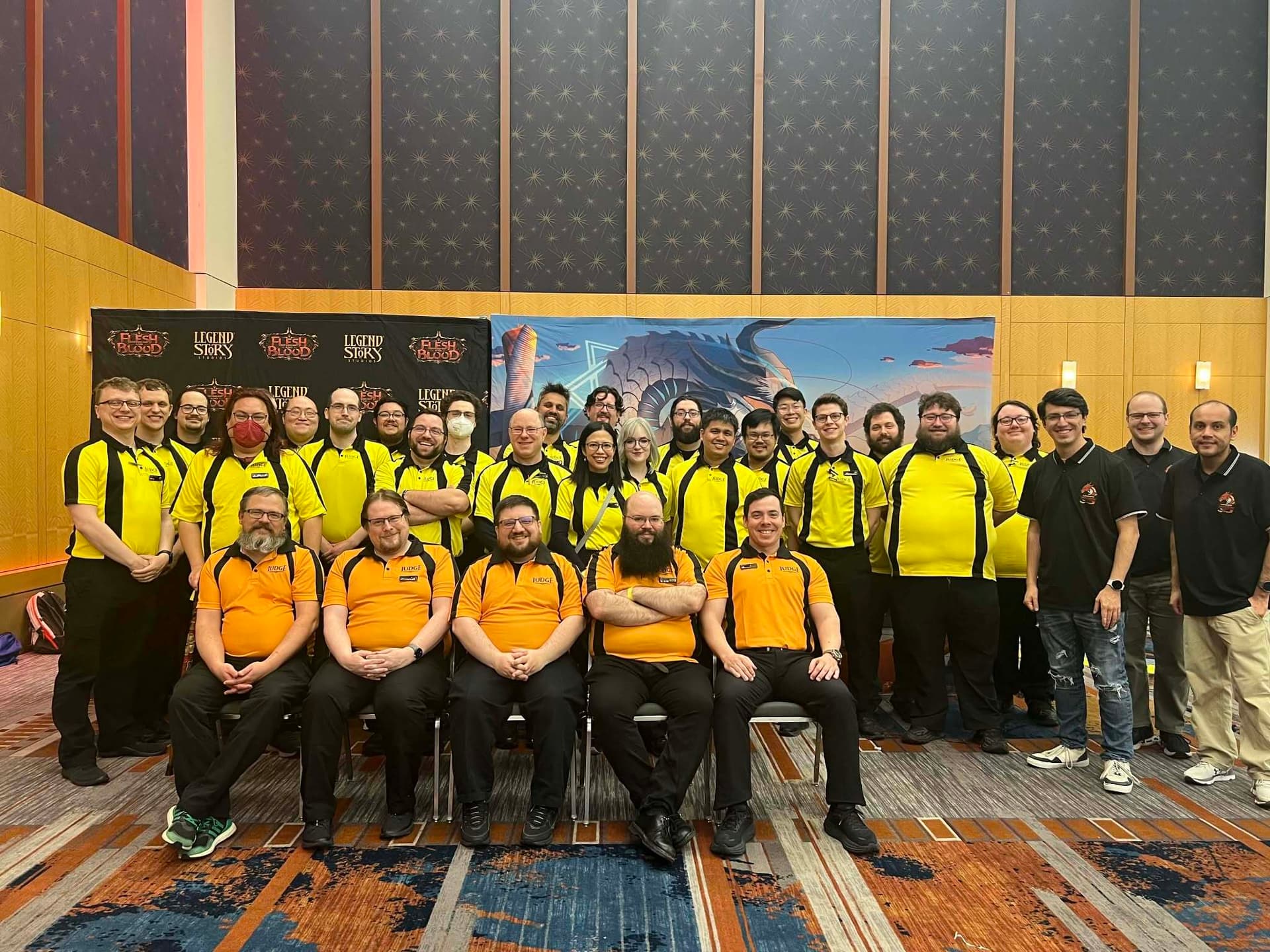
On the cusp of February, I was able to attend as a floor judge at Memphis on side events 1/31/25 and the limited Calling 2/1/25 at the Renasant Convention Center, conveniently located and connected to a Sheraton where many judges and players stayed. This was a cool event, as it was the first double Calling event, with a CC Calling starting Friday, and a Limited Calling (The Hunted) on Saturday.
For Sides on Friday, my lead was Brandon Welch and I worked with Roberto Vargas, Matthew Burger, Matthew Cudney, Matthew Tompkins, and Austin Hill (3 out of the 5 Matthews judging that weekend).
I had the opportunity to also float judge the CC Calling on Friday.
For Limited Calling on Saturday (Day 1), our Head judge was Ward Warren, Support judge was John Brian McCarthy, and I worked in the End of Round (EOR) team with lead Dan Collins and fellow judge Wella Anne Ladera.
I will split my report into several parts:
- Details of float judging the Day 1 CC Calling
- My experience on sides, and launching one of my largest events
- Details on all the logistics regarding the Day 1 Limited Calling — my first time participating on a team in a larger event setting
- A few judge calls from Saturday
- Final thoughts
Memphis CC Calling Day 1
We had 340 players join! I got the opportunity to float judge Rounds 3 & 4. Here are some judge calls that happened while I was floating around 🐝
Rate My Meld 🧐
Tyler plays Flicker Wisp, fusing it, and for their next action plays a melded card with type action and instant, choosing to meld the card, then calls a judge. Tyler asks if the melded card counts as an action card for Flicker Wisp to buff.
After consulting 8.3.38c, we inform Tyler that the melded card counts as both an action and instant card, and that all arcane damage is buffed by Flicker Wisp.
8.3.38c A melded card has the properties of both of its sides on a split-card: both names, and the combination of its abilities, supertypes, types, and subtypes. If melded card is not a split-card, it is unaffected by meld.
Seeing Double Hauntings 👓
Tyler is attacking with a Kodachi. In response, Nic with Vynnset discards a Haunting Rendition, in order to prevent 2 damage. After the Haunting resolves, in reactions, Tyler activates Flick Knives, flicking a dagger they control. In response, Nic discards a second Haunting Rendition, then calls a judge.
Nic asks if the first Haunting Rendition must be fully consumed before the second Haunting Rendition's prevention comes into effect, or can he order preventions in order to receive the runechants that each Haunting Rendition would apply.
After reading about prevention effects in 6.4.10 and shielding-prevention effects in 6.4.10j, we informed Nic that they can choose which prevention effect to apply to a damage event for replacement, and that Nic can choose to apply it so that each Haunting Rendition could reduce damage and create a runechant.
6.4.10 A prevention effect is a replacement effect that replaces a damage event with a modified event. Prevention effects are typically written in a format "[CONDITION?] prevent [PREVENTION]," where the CONDITION (if any) specifies the replacement condition, and PREVENTION is the modification which specifies the total amount of damage the effect can prevent, damage type(s) (if any), the shielded object(s) and/or source(s) of the damage event, and additional modifications to the event (if any).
6.4.10j A shielding-prevention effect is a prevention effect that acts as a shield. It prevents a specific amount of damage from any number of events that activate it. Shielding-prevention effects are typically written in the format "[CONDITION?] prevent the next [PREVENTION]." After a shielding-prevention effect prevents damage, any remaining prevention amount is used to prevent a future damage event. If the prevention amount of a shielding-prevention effect is reduced to zero, the effect ceases to exist.
Second-Guessing Tardiness Penalty 🥲
At the beginning of Round 4, I notice a table with only a single player and go to chat with them. After 2 minutes into the round, I see the missing player running to the table clearly exasperated, and when I tell them that they have a Tardiness penalty for being past 1 minute late in the round and receiving an IP2, they seemed quite dejected.
Even though I had studied and read up on the PPG beforehand, I was feeling the pressure at my second large event as an L2, and still learning to issue penalties. With that, I informed the late player I would read the PPG to make sure I had given the penalty correctly.
As I skimmed the "Tardiness" section, I misread an example talking about arriving 5 minutes into the round, second-guessed myself, and misinformed the player that they were fine and didn't need to receive an IP2.
As I walk away, I inform a fellow judge, who then educates me that I was correct in the first place, and I need to go back and let the player know. I inform the player of my mistake, and reapply the IP2, and he exclaims his frustration, with good reason, and appeals to the Head Judge.
Head Judge listens to the situation, brings me to the side and informs me that though we typically apply Tardiness Penalty to players after 1 min & the event is Comp REL, since a judge (yours truly) has created a bad customer experience in misinforming the player, we should waive the penalty in order to not continue to affect the player's mental state, and to make right for my mistake.
Afterwards, the Head Judge goes and informs the player that the penalty will be waived, I apologized directly to the player, and the players continued with start of game procedure, both looking way more relieved. I learned a valuable lesson in head smarts and street smarts in applying penalties.
Traversing the What? ✈️
Tyler attacks Nic, and Nic uses Traverse the Universe to block the attack. Afterwards, Nic moves to reactions with a dreact, and realizes that they missed their Traverse trigger, and calls a judge.
Issued a Caution for Missed Trigger, and since an additional action was taken, instead of doing a simple rewind, we applied a partial fix as if the triggered effect had been resolved at the correct point in the game, and allowed Nic to search for a Chi.
Memphis Friday Sides
After a couple rounds at the Day 1 CC Calling, I was imported back to sides team to Head Judge a 2PM Sealed promo event and support the launching of a 6PM sealed event. This was my first time running sides at a Calling, but I was fortunate to have skilled sides leads who coached me before and during the event. Even as I relive and share some of the tough experiences with running a large sides events, I was able to receive excellent mentorship, guidance, and support through it all.
My sides lead, Brandon Welch, followed up with me after the morning debrief to give me some pointers, help me prep, and encourage me with the upcoming sides I'd be running. Unfortunately, mid-day, he had to take leave due to not feeling well, and I received Brook Gardner-Durbin as my sides lead. He would always check in on me to see if I needed anything, and I learned a lot under his leadership: things like projecting my voice and how to care as a leader.
The venue hall was divided by vendors, with the sides events on one end, and the main event on the other. Whilst talking with the scorekeeper, we found out that the 2PM sealed promo event was going to start on the main event side, and if we ran out of room, leak across the hall to the sides tables.
2PM Sealed Promo Event
Initially, the sealed promo event started off with 80 players. And if we did go up, there was a single row (96 players capacity) as well as a few empty tables in the second row not occupied by the main event. So give or take, we would be able to fit 144 players max on the main event side. Shouldn't hit that number, right?
Of course, I started to worry, because:
- These promo events are usually popular and hit triple digits, and if it's sealed with the new set, people are definitely going to gun for it.
- TCG players are notorious for always doing things at the last minute.
- Murphy's law — if something can go "wrong", it will.
And of course, all three of my worries came into fruition. With joy and pain, I share that we ended with 154 players as the final number for the event 🥲
I know this is all Casual REL, but the first sides event I launched was a 6 player sealed event at a Battle Hardened, and I faced issues due to lack of experience. And now, I have been "promoted" to run a 154 player event, and you bet your butt I was internally mortified 😨
Thankfully, I was not without support and did my prep work. I had several floor judges who helped me with distributing product, and though I was told not to use the mic, I was able to (with a little bit of fumbling of words) give my head judge announcement and launch the sealed promo event. Unfortunately, I was down one judge because we had one judge always assigned to the sides event area to manage the players, make announcements, and answer judge calls, because my voice was not loud enough to project across the hall 🗣️
Small aside: at one point, because we were stretched thin, along with a mishap of breaks, and the main event requiring help, I found myself being the only judge to manage 154 players for a round or two, and that was probably the most stressed I'd ever been as a judge. My anxiety was at its peak because I was afraid that two players would make a judge call, though fortunately in my notes, it seems either that didn't happen, or I blocked it out from my memory if it did 😅
Fortunately the event ran to completion, we were able to flip the rounds in a reasonable time, and after 4 rounds, I had finished head judging my first 150+ player side event 🫡
One thing I learned throughout all this is that when head judging an event, especially one that hits greater than 64 people, your goal is to be in charge of overseeing logistics, delegating tasks, and solving all problems regarding the event. An event has a lot of moving parts, and the head judge is always on the lookout for issues and making sure nothing will bottleneck from having the event run smoothly.
I learned a lot whilst running this event, and can understand just a tidbit of what it takes to run a larger scale event, and how important the leads are in running logistics 🥹
6PM Sealed Promo Event
Unfortunately, I have no recollection of how this event went. The only notes I have for it was:
"I had 3 ghosts for…"
I believe I was there to help distribute product for the first round, which was quite fun, pick up trash, and help out with a bit of the first round, and then I was released from my shift — so apologies, but that's all you get from me for this event 😅
Memphis Limited Sealed Calling Day 1
We had a total of 261 players join!
Tech, Logistics, and Responsibilities 🛠️🗺️
Floor Judge 🧑⚖️
As usual, we had floor duties, but the Head and Support judge had 2 things we were required to do on the floor regarding calls:
- Have 1 judge shadow another judge who takes the call
- Have the judge who takes the call always consult with another judge
The purpose of this was for many reasons:
- It allowed for teamwork, synergy, and unity. Judges would be able to work together, and support one another in judge calls.
- It allowed for great customer service. Players would see that judges are trying to do their best to give the best and correct ruling possible. Example phrase: "I believe I have an answer, but let me talk to my colleague."
- It allowed for learning & mentorship to happen. Judges could experience a call without all the pressures that come with a call, with the added benefit of taking notes on how the call was approached, and can ask the judge afterwards (time permitting) their thought process in how they approached the call.
Additionally, we were required to bring specific penalties/fixes to different judges. This is all to ensure an extra check when enforcing these given penalties:
- IP2 for team leads (besides Tardiness)
- HCE/Partial fix, Deviation, DQ, etc. — to the Head and Support judge
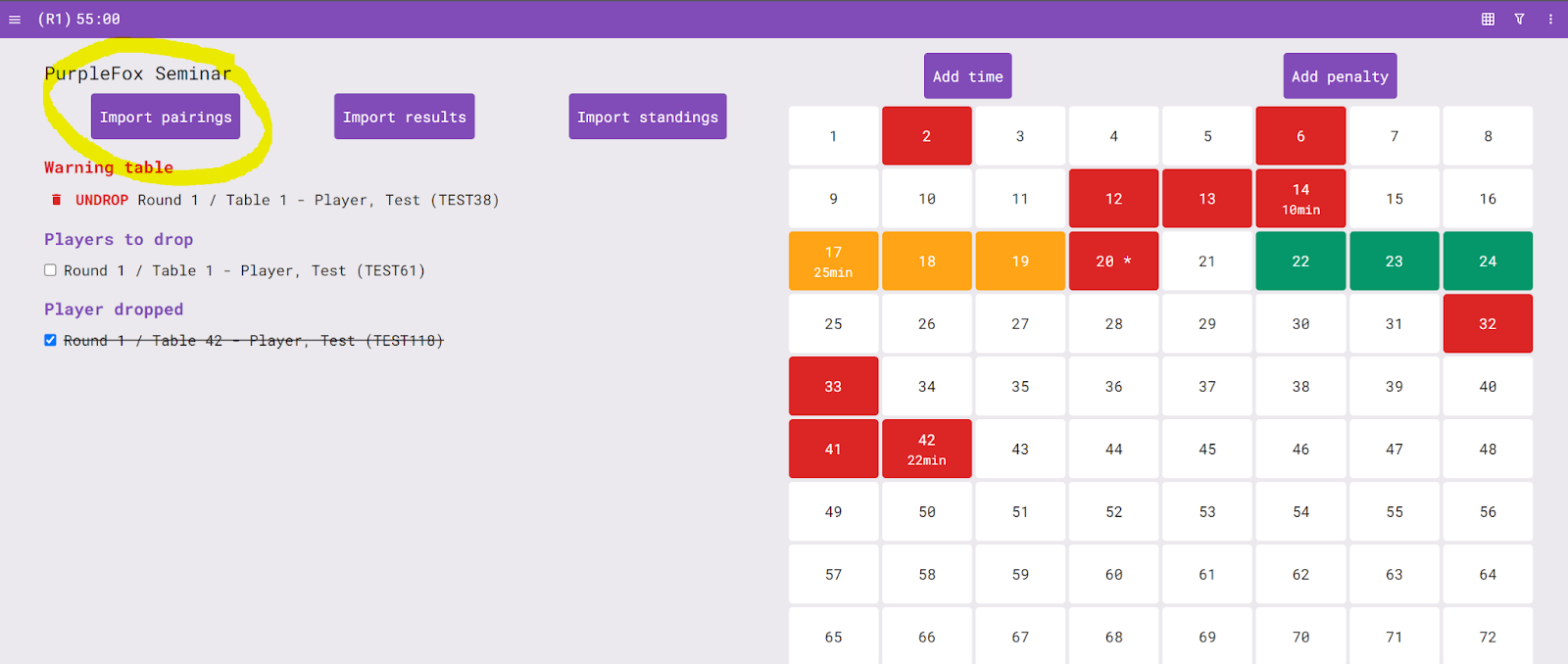
PurpleFox (Extensions, Penalty records, and More!!!) 🟪🦊
We used PurpleFox for penalties, round timers, and more. This was my first time using PurpleFox, and if you're not familiar with it, I'll give you a quick high-level crash course from a fellow judge (and Malört expert) while float judging the Day 1 CC Calling.
I will mainly focus on sharing my perspective as someone who managed End of Round, and worked with the Floor view.
The 3 goals PurpleFox is used for:
- To show the clock
- Have an overview of the floor (# of rounds, # of tables, table status, etc.)
- Have the ability to pull and update all information regarding the floor
In Floor view, you can:
- Search for a player and their tables
- Allow the scorekeeper to manage the score for each table
- Show and edit a table's status (empty 🟩, playing 🟥, judge assigned 🟧, or default status ⬜)
- See judges sitting/watching certain tables
- View time extensions given to tables
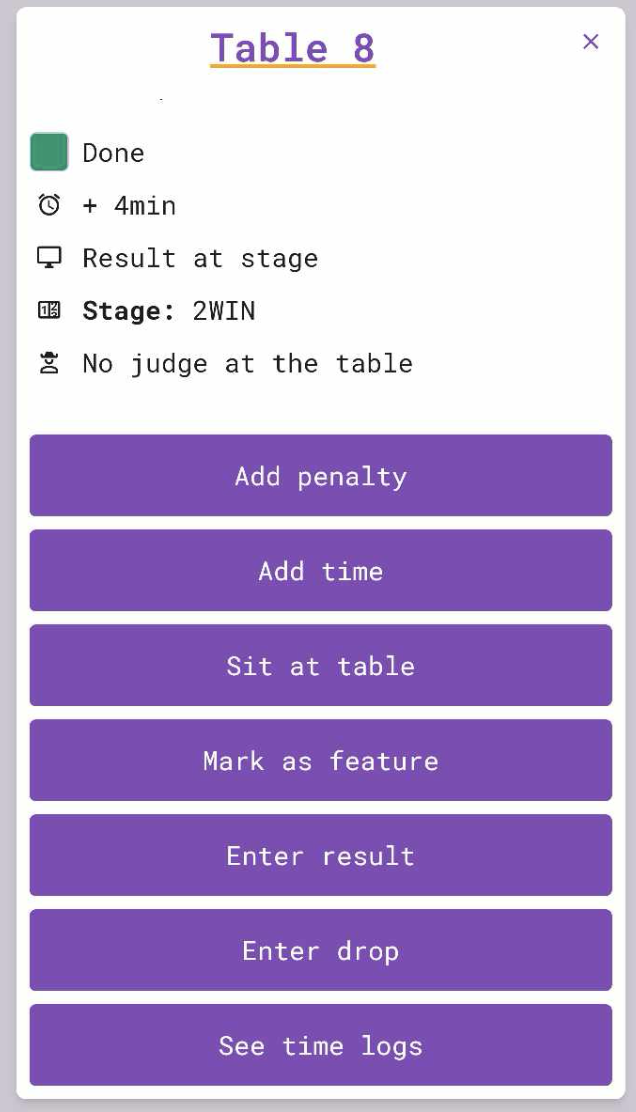
When you enter a table you will see the player's name (hidden for privacy reasons) as well as more details related to the table, each one used to communicate different details to other judges, especially to the scorekeeper and the EOR team.
End of Round ⏲️
Dan Collins was my lead, and I got to work with Wella Anne Ladera for the End of Round Team.
The goal for the End of Round team is less about giving a positive experience, and more so ensuring no negative hiccups or experiences happen when approaching the end of round — specifically in gathering all the results into GEM and flipping the round in a timely manner.
Our tasks as a team:
- Keep PurpleFox info up to date, which required sweeps (walking table to table, checking the status, and updating PurpleFox)
- Call out no-shows
- Delegate other judges to sit at tables that had players still playing after all sweeps were complete
Dan managed the mic to call out no-shows and set tables to red in PurpleFox, so at 11 mins to end of round, Wella and I would sweep from both ends of the floor from the highest and lowest table #. After sweeps were done, we would scan PurpleFox and start delegating judges to different tables, prioritizing tables that had 10+ min time extensions (tables that had deck checks, extensive judge calls, or appeals). Since we were in charge of delegating, our goal was to be the last one to sit down.
The reason judges are delegated to sit at tables is because there is a psychology of playing faster when being watched, and our goal is to ensure matches are completed within a reasonable amount of time. After a table with a judge sitting there completes their match, the judge is also responsible for ensuring that players report before they either leave the table, or go take care of whatever things players do after they leave the table.
Tip: set an alarm for 11 mins before round ends to notify for sweep (thanks Wella).
Miscellaneous Judge Calls
It's a Trap! 🪤
Tyler (Arakni Marionette) triggers hero ability at end of turn, rolling a die and transforms into Arakni Trapdoor. They decide to search their deck, banish a card, and Tyler reveals the trap to Nic, not realizing the trap must be banished face down.
Both players call a judge, and ask if there was a game rule violation or issue with revealing the hidden card.
We informed both players that though the trap is supposed to be banished face down, since Tyler is the owner of the private information, they can choose to reveal the card, and there is no violation or penalty that needs to be issued.
Soooooooo… 👀
Judge hears Tyler at the end of the round say the statement clearly: "Is there anything we need to do before taking a game action."
We pause the game and get the Head/Support Judge, after hearing this statement, since suggesting or pressuring an opponent to concede or to end the game/match, in any form, is considered to be asking for a concession.
Tyler is informed that this is Improper Concession, but since the round has already expired, a match loss is issued for the next round instead.
Since we wanted to keep the tournament moving, we told the player that they could appeal, but would have to do it after the current game is finished.
It's Two Traps?!? 🪤🪤
Tyler (Enigma) attacks Nic (Riptide) with a Ward. After passing to reactions, Tyler responds with Astral Etchings, putting 3 counters onto the ward. After Astral Etchings resolves, Nic plays a trap in the reaction step that triggers Riptide's ability.
Before the Riptide ability resolves, Tyler responds by playing a Ward 3 and resolves it, aiming to prevent the Riptide trigger from killing the Ward. Nic responds by playing a second trap, and Tyler calls a judge, asking how the Riptide triggers and traps would work if the attacking Ward were to be destroyed.
We learned that Enigma can order prevention effects so that the attacking ward will be destroyed, which closes the combat chain. With it, both dreacts go to the graveyard and the 2nd Riptide trigger fails as the trap fails to resolve. With it, Enigma can keep the Ward 3 that was placed.
Conclusion
Overall, I was very appreciative of all the many judges that were willing to mentor and support me at my first large Calling. Unlike my previous event, where I got a lot more opportunity to answer judge calls and take notes on different penalties and rulings, I felt like with a larger event, I had a lot more logistics I had to learn and execute on, and I got to witness all the moving parts that goes into ensuring an event at this scale is successful.
With that, it was a privilege to write this report for you all. I am looking forward to the comments and feedback y'all have to give, and till next tournament report 🫡